

If you ask a hundred serious poker players the number one reason why they play the game, I would bet that monetary gain would be the top answer. However, I also think that most of the people who answered money could be convinced otherwise after a short conversation. The reality is most players - even a lot of top ones - could make more money per hour in a different industry. There are exceptions but I would guess they number in the hundreds rather than the thousands.
If a player can become so good at this game by committing the time and effort necessary to become a winning player, he is smart and diligent enough to do even better monetarily in a different industry if the same effort were extolled.
With that said, what “should” be the number one answer as to the primary motivator? I have to assume that the enjoyment of the game, the leisure atmosphere, competition, outwitting your opponents, glory of a big win, and socialization all something to do with it.
In other words… having fun.
Whether a player is a full time pro or works poker as a side hustle, it seems that having fun while making money fits the bill of why certain people are drawn to and continue to take poker seriously. On this scale between leisure and wealth accumulation, we all find our place. Some of us are skewed far to the leisure side but are extra pleased when our poker ledger is in the black for a specific time frame. Others need to make money to pay bills but love the idea of taking a photo with a trophy once in a while.
For those of us that skew to the enjoyment side, we find ourselves on the cushioned side of the mental game. That’s not to say it’s all easy. When we go on a downswing, it doesn’t feel good. We question our game and wonder what we should work on to help things improve.
However, we shouldn’t have to wonder if we are going to be able to pay the rent. We have the luxury of enjoying the moment in every game - large and small - and not feel the weight of expectations to the extent of our counterparts.
I am a winning player but I am grateful everyday that I don’t have to be. This allows me to have fun every session. Sometimes, I have fun watching others enjoy their experience and sometimes I can help them have a great experience which adds value to my own.
During the summer of 2024, I played in a $800 NLHE tournament at Aria. I was in the 9 seat and a capable but very green player in the 7 seat was absolutely beaming just to be there. He was young and I got the feeling that this was, perhaps, his first tournament over $500 or so. Every time he won a pot - try as he did - he couldn’t stifle his smile and happiness. It was infectious to the point that when he all but felted me with his AK vs my AQ on a dry Ace high board, I was genuinely happy for him.
Seat 8 joined in on the fun and we began asking him where he was from and shared a few on the fly tips for playing tournaments during the summer.
Sometimes when I am sitting at a table of bros that are all too cool for each other, I think of that young man and how his attitude and excitement lit up our side of the table.
Anyone in my poker circle can tell you that I preach having empathy for the opponents we face. This isn’t to say that you feel sorry for them or sad that you stacked them. Empathy simply means understanding what they are feeling in the moment and can associate it to times you have been in a similar spot.
I never apologize for knocking someone out of a tournament but I try to be empathetic. I say “Good luck tomorrow”, “ You played well”, or “It was nice to meet you” depending on what the truth may be. I try not to say things like “Why would you call there?”, “Sweet… now we are in the money!”, or “At least you got it in good”. We have all gotten sucked out on, misunderstood the situation, or simply punted. I don’t need someone to point it out to me when something like this happens and I don’t want to be the person that is doing the pointing when unfortunate things are happening to others.
Empathy, however, doesn’t always have to be derived of a negative result. We can empathize when we see someone win a tournament or get a score because of how it reminds us of how we felt when something special happened to us.
The WSOP Circuit in Austin this past spring had me playing in the Seniors event approaching the bubble when a conversation was struck up with an older gentleman1 to my immediate right in the 8 seat. I was in the 9 seat2 and the aggressive player in the 1 seat was really abusing the table with his big stack. This is good strategy and I would never hold that against a player. However, he was also being very vocally aggressive and confrontational.
I’m not a big staller but I started working that into my strategy in an effort to cool of seat 1 by denying him the frequency of hands he desired. I could see that the table breaking crew was headed our direction and would perhaps be lending me some reprieve in the form or a new table assignment in the next half hour or so. Around this time, my friend in the 8 seat - who was nursing a short stack of around 10 big blinds - confided in me that he has never cashed in an event that would be reported to Hendon Mob3. He had driven a couple hours and really wanted to tell his wife that he cashed a “big” event.
I took a look at his stack and the number of players left to the money and asked him if he was sure that those were his goals. When he said yes, I smiled and replied “Lets make it happen!” Let me say that I wasn’t willing to sacrifice my tournament goals for this person but the strategy to get to his goals matched what I was already incentivized to do. I just dialed it up a few notches. I told him to fold every hand no matter the holdings4 but to wait at least 35 seconds before doing so and I would do the same. He had a hard time as he felt uncomfortable stalling that much. I assured him that, besides the player in seat 1, nobody was likely to complain in this setup.
With 3 players left to go to the bubble, our table broke. My guy had 3 big blinds left. I told him to take his time going to his assigned seat and to stall until they announce hand for hand play.
I was moved to another table but could see my friend from my vantage point. We went a few hands at my new table before the TD announced hand for hand play. 5 hands later the bubble burst and the gentleman I was watching suddenly threw his hands in the air in the victory formation. Two hands later and he was walking to the rail in my direction. Grinning ear to ear he told me that he had a half a big blind left when he made the money. I told him congratulations.
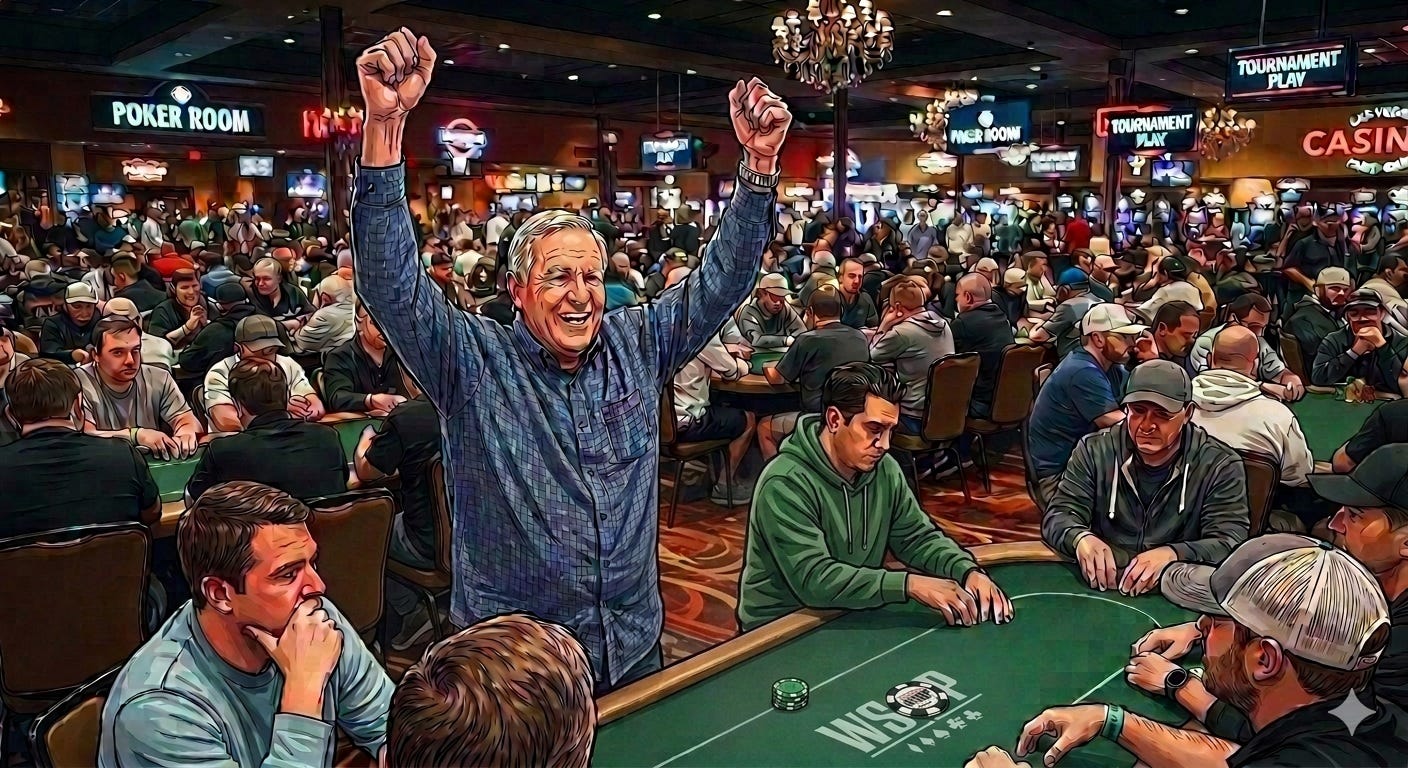
A few minutes later, a waitress approached me and asked me what I would like to drink as the gentleman at the bar was footing the bill for anything I choose. I ordered a sparkling water and was able to toast him from a distance as he left towards the cage a winner.
I finished 32nd out of 468 entries5 in that tournament. However, the empathetic joy I received from seeing that gentleman proudly walking to the payout cage trumped my payout walk in the form of dividends I continue to enjoy from that memory.
It wasn’t about the money - it often isn’t.
If you enjoyed this essay, please consider hitting the like (heart) button.
As always, thank you for reading.
Perhaps in his 70s.
I really don’t like that seat but I suppose feel good stories come from it
Hendon Mob is a database of tournament poker results. You can type in a name and find out what events that person has cashed. It is helpful to tournament players to look up results of their opponents but, more importantly, the average buyin that the player typically plays.
A trick to do this without falling into a trap when you see a hand that you “have to” play is one that I shared with this fellow. Many moons ago I read in a satellite strategy book - Either O’Kearney or Lee - to close your eyes when you apex the cards so that you are in the dark with your holdings but you opponents can assume that you are aware of them.
I looked it up.
One thing I’ve come to appreciate over the years is that we often evaluate other players as though everyone at the table is trying to accomplish the same thing. If our primary objective is long-term profit, we naturally judge every call, raise, and fold through the lens of expected value. When someone calls raises with terrible hands, chases draws without the proper price, or simply refuses to fold, the immediate conclusion is often that the player doesn’t understand the game. Sometimes that is certainly true. But sometimes we may be judging the decision against an objective the player never had in the first place.
People play poker for all kinds of reasons: profit, competition, entertainment, social interaction, excitement, challenge, or simply something enjoyable to do for a few hours. Usually several of those motivations exist at the same time; what matters is which one dominates the player’s decisions. The person who came to gamble and have fun may place real value on seeing flops and being involved in the action, while the profit-focused player is perfectly content folding for an hour. The resulting strategies may be completely different because the objectives are different.
None of that makes an unprofitable decision mathematically correct. A bad call remains a bad call from an expected-value standpoint. But understanding why someone is willing to make that call can tell us something important about how that player thinks. Instead of simply asking, “Why would anyone play the hand that way?” I’ve increasingly found it useful to ask a different question: What is this player actually trying to get out of the game? Once that becomes clearer, behavior that initially looked inexplicable often becomes much easier to understand—and potentially much easier to play against.
Great write up Mike!! As you have played many live poker games with me you know my number one goal is to have fun. Don’t get me wrong, it’s great to win but if winning is your only goal poker is going to get very frustrating very quickly!! I love to have fun at the poker table,but I also like to win!!!