

There are plenty of nicknames out there for specific hand combinations in NLH. Some are obvious like “Ladies” for pocket Queens. Some are overused like “Jiggitys” for Jacks. At least one is named after a legendary player in T2 being the “Doyle Brunson”. Interstate 610 makes a loop around the city of Houston. This lends itself to a Southeast Texas regional nickname for T6 in “The Loop”.
Well a few months back, my friend Chris1 coined his own. He monikered the K6o the “Watson” while it’s suited cousin carries “Sherlock”. Why you may ask? Its Elementary of Course!2
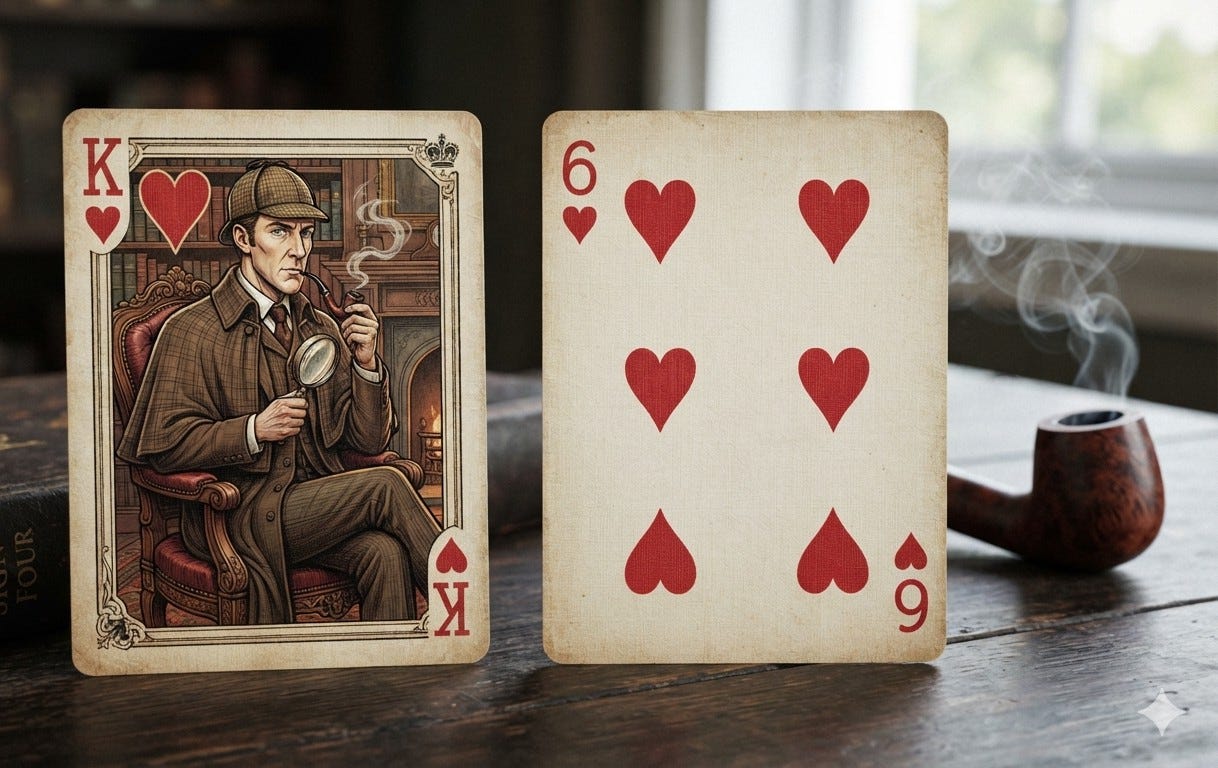
Gathering Information
While Mr. Holmes is on our minds, lets get to the theme of today’s essay. Each time we sit at the poker table we should be actively picking up clues. Some tidbits are easy. Is the person to my right opening too many hands? Is the person in the Big Blind calling raises too much? These are questions that we are all asking ourselves subconsciously at most any level.
Some players are looking slightly deeper and looking at why a player would open to 3 big blinds on one hand and then to 2 big blinds on the next. Picking up these clues is the first step to exploitation and straying from our balanced game.
Acting on the Information
Once we have a sufficient amount of evidence to make an exploitative play, we still should only make a relatively small detour from our equilibrium game. This is because - while we are confident in the clues we have gathered on this player - there are usually other players in our way or yet to act. We don’t want to get way out in the weeds with our ranges or sizing.
This is ultimately because every time we drift from equilibrium - or our best flawed attempt at GTO3 - we open ourselves up to be exploited.
Imagine that we find out through playing all day at a table that a player seems to overfold to over-bets but tends to overcall when facing 3/4 pot size bets on the river. We may think that we can exploit this by over-betting our bluffs and betting 3/4 pot with our value hands against this opponent as an exploit. However, if this is sniffed out by our opponent playing detective in her own right, you may get a lot of rivers checked to you and start to get hero called on your over-bets and folds to your 3/4 pot bets.
This is the next level of paying attention at the table. It’s paying attention to who is paying attention. This is important but also requires nuance. For example, I always advise beginners to at least act like they are paying attention to every hand even when they have no stake in it and may not even understand what they are looking for or at. On the other hand, some savvy players play the dolt but are actually noting all that happens with their “peripheral attention”. In summary, it can be difficult sometimes.
Offense vs. Defense
You can typically tell the seasoned player from an inexperienced one in a major tournament as the veteran will start conversations like “Where are you from?”, “Has anyone played this event before?”, “Are you planning on playing the X tournament this weekend?” These all seem like benign conversation starters from a friendly person and they kind of are. This player wants to get to know you. He wants you - believe it or not - to have fun, relax, and enjoy yourself. He also wants to know infomation he can use against you in game. If this player knows that you are from Nebraska, haven’t played this event before, and didn’t even know about tournament X this weekend, he will have enough information to reliably classify you as someone who doesn’t play at a regulated casino very often (as Nebraska’s selection is scant), may be taking a shot / not familiar with the structure since you haven’t played this event before, and not a regular as you aren’t familiar with the upcoming schedule.
This is why veteran players talk up the table. It’s also why inexperienced player should play “clue defense”. As information will disproportionatley favor the experienced player, equilibrium should look like some players trying to create an environment that is ripe for gathering clues and others protecting themselves by trying to give off as few as possible.
If you are an inexperienced player, you may be saying to yourself: “How do you expect me to gather clues while I’m spending most of my time trying to play ‘clue defense’?” The first answer is to look at who is asking the questions at the table. This is a great clue that this player is confident and is doing his part. Watch out for this player as he is likely to be better than average in skill level. You can also listen to the answers of the players who are responding to the questions being asked by said veteran. You can glean a ton of clues in this situation without opening yourself up.
All of this said, I have seen talkative players that were just blabbing about mush and inexperienced players that want to talk in an effort to get rid of nervous jitters. There are very few “Always” and “Nevers” in life or on the felt and the number of things to look or listen for are too many to list.
These are only some very rough beginning guidelines. Its up to you and your detective work to separate the wheat from the chaff. One thing is for sure, you will not get better at sussing out reads and exploits unless you practice. That typically means putting the phone down, stop watching the game on the big screen and start paying attention to the action and voices around the oval.
You are welcome to leave the pipe and goofy hat at home. But you should absolutely be playing your best detective while at the tables.
If you enjoyed this essay, please consider liking it below. If you have any input or questions, please comment below or email me at MikieCulpepper@gmail.com
As always, thank you for reading.
In the case that this nickname takes off, he can be credited by his full name Christopher Inman.
Just in case you are still scratching your head or are an international reader, American primary schools are typically Kindergarten (K) through 6th grade. Hence K-6.
GTO - Game Theory Optimal. Game Theory is the study of actions that take into acount the potential actions and reactions of other players. Game Theory is used in marketing, economics, warfare, and - yes - some games. This study is not specific to poker but the game of poker - especially when bet sizings are as vast as no limit - makes finding equilibrium very profound and complicated. It is assumed that a human can not replicate a GTO solve for the game of NLH.
I believe sir Doyle is writing a work of Holmes is Watson and Watson is Holmes. I certainly geeked out on the Card Name but I am the proverbial Watson that was overly amused by the “Elementary” & obvious name that our esteemed detective took note of. Tip your hats to sir Doyle my friends, he is the best detective I know.
When I first started playing, I never talked to anyone. I needed to focus on the play, didn't want to give away any clues, wanted to be mysterious, and didn't think I had anything in common with the other players. As I play more, I like to talk to players I respect. I also ask obvious tourists where they're from, just to be friendly. I can already tell if they're amateurs or cash players in a tournament by how they play. However, I've run into players who ask each player questions about themselves nonstop, and I refuse to answer. I don't know if that person is trying to get info about their play, trying to distract everyone, or just unstable. I'm silent around players who talk too much.