

Tournament poker is the nuts. Giant prizes, dozens - or hundreds - of tables, laddering implications, and keeping track of much more than the eight other players at your table can make your head spin. Fortunately, we have the tournament clock board to give us some insight and perspective.
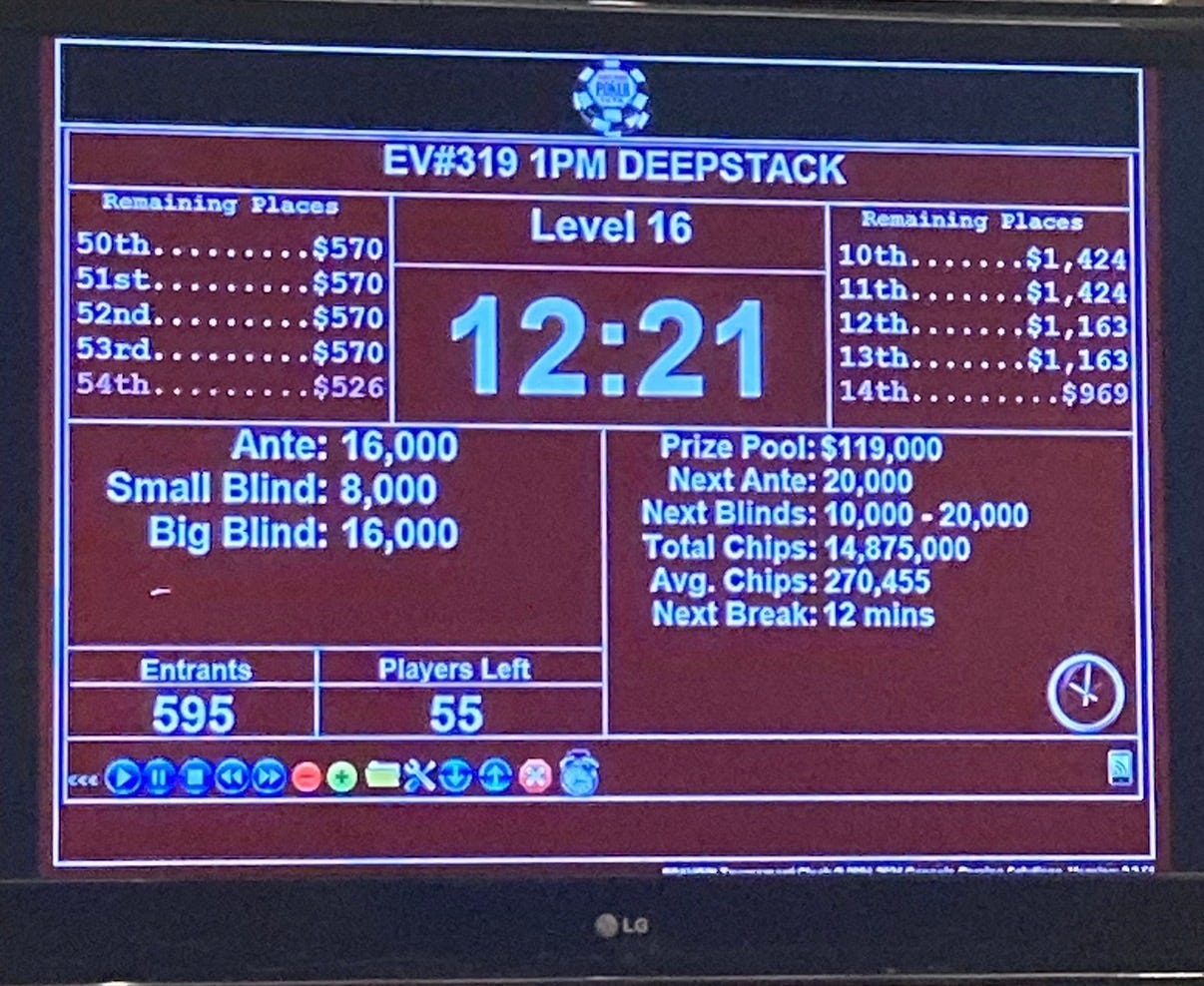
The board which primarily serves as a tournament clock to let players and dealers know when the blind levels change has a lot of other helpful information within. A typical tournament board will contain the buy in amount, any guarantee, the current and next blind level, number of total entries and how many runners are still in the tournament, whether registration is still open, whether the players are in the money (ITM), the average stack size, and any upcoming breaks. After the tournament is ITM, the board will show payouts for each place.
Hopefully if you are in the tournament you already know the amount for which you bought in, the guaranteed prize pool, and the current blind level.
The next blind level can be a useful bit of information especially if it will be an “awkward” level in which the small blind (SB) makes up more than half the big blind (BB). An example could be a level of SB1000/BB1500/BBA1500. During these levels, expect the small blind to complete if it is folded to her - or it is a limped pot - more often than in the typical situation where the BB is double the SB. This is because of the pot odds being offered to the SB. Because of this, the BB has more raises to a SB limp as he realizes that the SB is completing wider than she typically would. This can become a leveling situation if it is perceived that the respective players are in the know to this situation and the dynamics presented.
If you are playing a reentry tournament, it can be really important to keep an eye on whether registration is still open. In certain events and against certain opponents, play can be WILDLY different before the close of registration and after. It is a complaint of many recreational and large field runners that players with deep pockets will fire many bullets (entries) into reentry events and play very wide and aggressive until late registration is closed. Rather than complain, do a combination of game selection and player profiling to play these spots as best you can. However, whatever style you play to get through the late registration period, it is imperative to “shift gears” after late registration is over. At this point, no matter the player’s tendencies or bankroll, the tournament has essentially become a freezeout. Players that a few hands ago were playing wildly and putting maximum pressure on others that they deemed as “scared recs” will now be staying in their lane and playing in a more typical and fundamental fashion.
The number of players left in the field and the total number of entries is pertinent information in that it can give you a rough idea of where the money bubble will find itself. This number becomes much more accurate as the close of registration gets closer. You just need to multiply the number of entries times the percentage of the field that gets paid. For instance, in a 500 player field that pays 12% of the runners, the bubble should happen at the 60th place player (500*.12).
The break schedule is important to know so you can time your needs such as bathroom breaks, smoking, eating, stretching, or studying. It’s important to know how long your break is as you are leaving the table. I like to set an alarm for a minute or two less than the break clock to ensure I am back at the table without missing a hand. I like to walk and get my cardiovascular system some repetitions after my restroom break. If you decide you want to study some poker charts or ask the wizard about a hand that you played in the last level, be careful and know the rules. Most poker tours and poker rooms don’t allow Real Time Assistance (RTA) in the “poker arena”. Finding a place out of the room may be your best bet.
After late reg ends and the money bubble has popped, the real fun begins. At this point, our big board will be displaying the payout schedule. If you are fortunate enough to have a clear view of the board, this can be advantageous. In large fields, this includes pay jump groupings that can act as a mini ICM laddering spot. For example, if you are sitting on a marginal shoving hand with 8 BBs in a large field with 8 tables still left and look up to see that the next pay jump will happen after one more bust out, it may be appropriate to wait for a better spot and get the pay jump.
One person to look for is the player at your table that is constantly looking at the board. If you feel like he is looking at the board to see when the next pay jump is coming, the prize may represent a large chunk of his bankroll or poker budget. If you perceive the pay jump is really important to him, you can put extra pressure on him and may get folds that you typically wouldn’t.
This brings us to the most overused and misused statistic on the big board - the average stack. The Average Stack is not the median stack in the tournament. There is no magic that is done to come up with this number. The average stack in a no add on tournament is simply:
(# of entries * starting stack size) / # of players left in the field.
Here are a couple examples:
Tournament A has 7 players left out of 40 entries that started with 20,000 chips, the average stack is (40*20,000)/7 = 114,000 chips.
Tournament B has 8500 players left out of 10,000 entries that started with 60,000 in chips. Average stack is (10,000*60,000)/8500 = 70,550 in chips.
Simple enough for sure. Also, depending on the point in the tournament, perhaps akin to useless information. While it may seem to be a nice point on which to reference your chip stack to your friends at break it really doesn’t mean much when it comes to the health of your stack in comparison to this average. This is because it doesn’t cross reference the blind level, the duration of the blind level, or the stack sizes of the players that are actually at your table.
Tournament A is based on a local twice weekly game at our local VFW. When we get to 7 handed at the final table as listed above, we are usually at the 5,000/10,000 level. This puts the “average” stack at around 11.5 BBs. Some players are going to have around 400,000 chips and others will have only a couple big blinds. We will be on or near the money bubble. All of the players left in the field are at the same table and it is obvious who is the chip leader, who the short stacks are, who has a skill advantage, and the prize laddering effects should be on this dwindling field. The blind levels are 15 minutes and there is no ante in this tournament. The average stack, essentially, means nothing in this situation.
Tournament B is based on the WSOP Main Event. It’s a freezeout and by the time it gets to 8500 runners, it is early day 2 and the blind level is likely at 500/1000/1000. The average stack represents over 70 Big Blinds! We are nowhere near the money bubble (usually late day 3 or early day 4) and in multiple event rooms so large, it would be impossible to keep track of the stacks of more than a couple tables. The table at which we are playing could well have every player below the average stack - or every player above the average stack - further muddying the value of the average stack statistic. We are essentially playing our table without much regard to the tournament as a whole. The blind levels are 2 hours and there is a big blind ante. In this scenario, even if we have half the average stack, we have over 35 Big blinds for perhaps another 2 hours! The average stack, essentially, means nothing in this situation.
With these two extremely different examples, I claim that in neither does the “average stack” statistic mean much at all. If this is the case, why do players reference it at all and why does this statistic take up space of both the tournament board and our collective minds?
The answer is we tend to want to use it to determine the health of our stack. After all, if we are doing “better than average” that has to be good or at least pertinent right? Sadly no. The health of a tournament stack is measured in either big blinds or “M1”. In either case, player strategy should be dictated on the number of big blinds in the effective stack of a hand. For instance, from UTG at 80 BBs KJo is an open fold. However from the same position with 9 BBs, it is an all in.
Because the number of big blinds in a player’s stack dictates the appropriate strategy, it makes sense that the health of a player’s tournament should also be measured by the same metric.
If there is any poker terminology that I may be guilty of overusing, it is “Count your big blinds” or “Count your Bigs”. I constantly say this both to myself and to anyone that I am giving advice. It is one thing you can control and one thing you should always be mindful of.
If you just sucked out on an all in and doubled up, don’t think about how you should have folded or how happy you are that your are “back in the tournament”. Count your Bigs. If, on the other hand, your JJ just lost half your stack to 43o on a ridiculous call, don’t sulk and don’t berate your table mate for a bad call. Count your Bigs.
By counting your big blinds you are preparing yourself for the next hand and the strategy you should be using. By counting your big blinds, you are also mentally resetting and completing an action item that “turns the page” on whatever just happened. This helps to put yourself in the correct mindset going forward and can also can help avoid tilt.
Lets say you are the big stack and lose a cooler to another sizable stack. Some players can’t stop thinking of that high water mark they had. He tells himself: “ I was up to 350,000 in chips and one of the leaders of the whole tournament and now I’ve only got 110,000 left - I need to get back to 350K”. However, if this player just counts his big blinds and finds he still has 80 BBs and a very healthy stack, perhaps this information that was right under his nose can help cool the rest of his head.
So next time you are in a tournament and look up at the tournament board whether it be a jumbo tron or a small television, keep in mind that there is a lot of important details in this electronic wall of information. Most of it is used best in conjunction with the other information on the board. However, when you go on break, don’t bother looking at the average stack….
Count your Bigs.
If you enjoyed this article, please consider liking by clicking the “heart” icon below. If you have any questions, please feel free to leave a comment and we can discuss. Lastly, thank you for reading and subscribing.
“M” is the number of orbits it would take for a player to blind out. This number accounts for the amount of forced blinds and antes per orbit. This is usually the BB + SB + antes. While Dan Harrington did an admirable job trying to get “M” to gain traction, most players still use number of Big Blinds when calculating a stack size and health.
Great post!