

Emotions swell in all aspects of our lives. They are instinctual tools that help us survive on a primal level. Feelings of Fear, Anger, Joy, and Jealousy are not deliberate choices that can be turned on or off. Emotions are built into us. What makes things more messy is that they are built into one person differently - and to a different degree - than they are into the next.
Through nurture, we are taught to express or repress certain emotions depending on the circumstances and degree of the situation as well as perceived social norms. The level and application of this “nurture” can further affect the very emotions and frequency that are being expressed or repressed at the time.
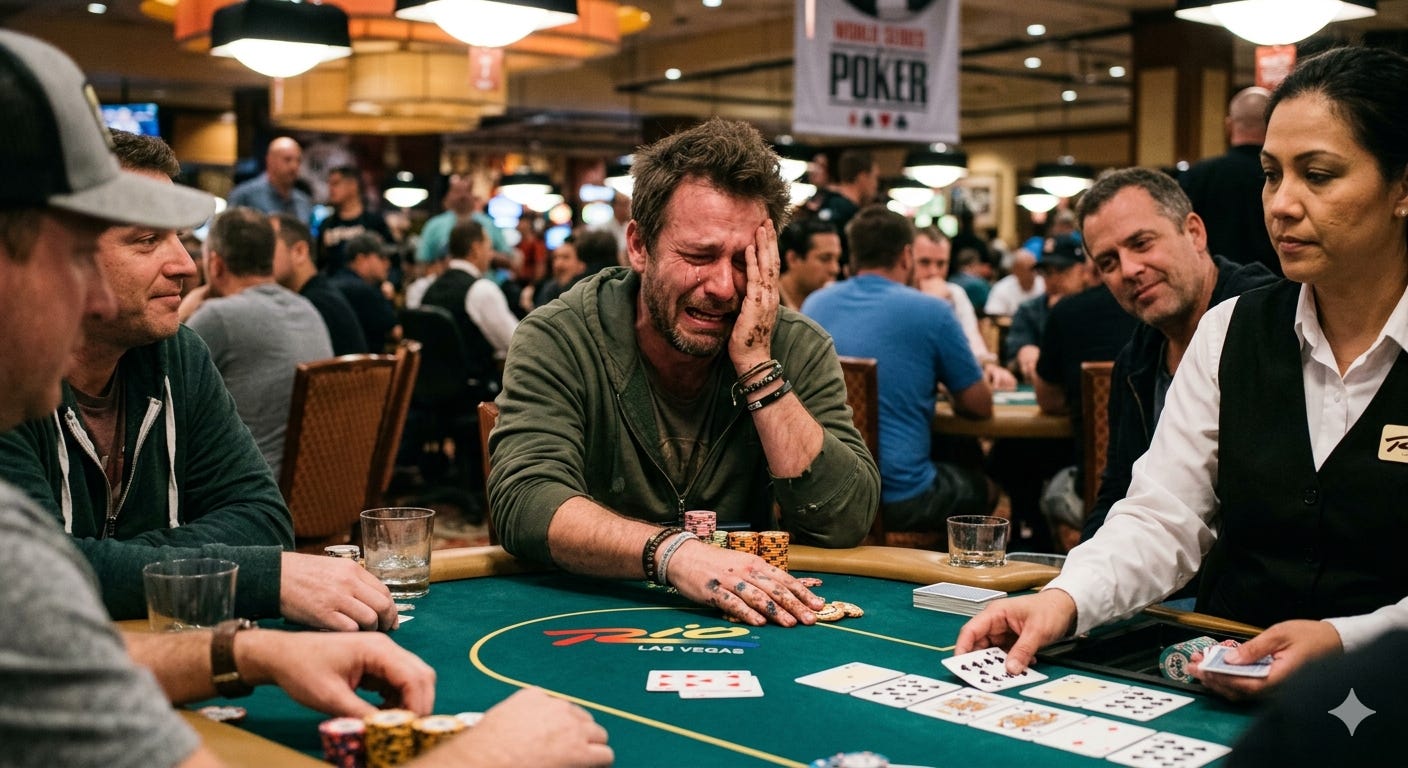
This is all to say we are born differently from each other and we are also raised and instilled with different ways of dealing with emotions. None of this should come as any surprise to anyone with eyes, ears, or empathy. I would like to think we are all trying to do our best to regulate our emotions as best as we can.
In sports, we may realize - logically at least - that just because the winner of this baseball game gets to go to state, this is not a good biological reason for players to become overly emotional about the outcome. On the other hand, perhaps if I am the one looking down a 94 mph fastball whirling towards my head, I may feel differently.
Which takes us to a place where emotions run high without fear for life or safety.1 The poker felt is a competitive environment without doubt. It is also a place where we see players handle emotions on a wide spectrum.
You see it happen all too often from loss of verbal control to a top name pro blow up moment. Of course emotions spike for various reasons but the key ingredient usually involves pressure or friction on the aspect of the game that motivates that particular player. Non players usually think it’s about the money. The reality is as long as a person is playing within his bankroll2, he shouldn’t be any more emotional about losing a buyin than he would be paying $15 for a beer at a MLB game.
I have become overly emotional at the table more times than I would like to admit. There is one instance that stands out in my mind from a few years back in which a player put my top 2 pair to the test on the flop. I called his all in and found out the bad news. He had flopped bottom set. When the turn card filled my boat, I slapped the table and exclaimed “YES!”. I couldn’t believe that I had emotionally lost myself like that and immediately regretted it and apologized to my opponent and the table. I ran quite deep in that tournament and was embarrassed -which is also an emotion that I over blew that day - the rest of the tournament despite my table mates not making a thing of it at all.
Why would they? I hear players yelling from across the room “L-F-G!” all day and night long, players getting so upset at other player - and dealers! - that they want to physically fight. It’s not like people just get emotional at the poker table. This is happening everywhere it seems. My point is the poker table seems like a place where it shouldn’t be happening as often.
Any counselor worth her salt will also tell you that beating yourself up about an emotional outburst doesn’t solve anything. This is just emotional baggage on top of the other. It is best to acknowledge, sit with the idea without judgment, and move forward using systems to avoid this pitfall in the future.
So what are some ways we can emotionally regulate before and when we sit down to play?
Play games that are within your budget or bankroll.
Confirm with yourself that the best you can do is make the correct decision each time it is your turn to act. If you feel like you made a bad decision, write it down and look it up afterwards but be able to let it go and move on.
Let go of the idea that you have control over things like the random cards that present themselves. You aren’t responsible for this part of the game. You can let go of being upset by luck (or bad luck).
The other players at the table want to win and have a good time as well. Don’t ruin their time just because things aren’t going your way especially if you are going to be playing against these opponents again.
Use breathing exercises from meditation or yoga training. Breathing calms and helps to regulate the highs and lows. Premature celebration can take a lot of energy from you when you realize there is still a battle to fight.
Don’t let yourself get worked up in a hand against your rival. The player with the better emotional control has an advantage.
It’s also important to give beginners and young people a break when they show too much emotion at the table. If we think back to our beginnings with the game, I’m sure many of us would be embarrassed with that version of ourselves and probably have some good advice for that person.3
Emotions have a place in life and on the felt. It’s great to see someone happy that they won a pot. Disappointment is almost mandatory when busting a tournament. Humans shouldn’t strive to be emotionless robots. We should, however strive to be properly emotionally regulated for the moment at hand.
If you enjoyed this essay, please consider hitting the Like (heart) button below. As always, if you have any questions, feel free to leave them in the comments or email me at mikieculpepper@gmail.com. And once again, thank you for reading.
One more note:
I’ve created a separate “Club News” section for updates about our poker group (events, results, etc.) in an effort to bring you only the information you want.
If you’re not part of the club—or just not interested—you can easily opt out of that section and keep getting only the strategy content like this essay.
Click manage your subscription on the upper right if you would like to opt out of the “Freezeout Poker Club News” section of this Substack.
Unless you find yourself at a certain card room in Houston, TX.
There are plenty that are playing above what their bankrolls dictate. This is more of a money management problem that leads to emotional problem.
That would likely be ignored.
Well written. I cringe when I think of the many different ways I’ve reacted to other player’s bad beats or bad attitudes at the table early-on in my nlh learning years. When I can stay emotionally regulated these days, it’s easier to focus on the entire purpose I’m at the table - to play this game that is so much fun. It also makes it easier to shrug off those bad beats or attitudes when they do arise from opponents and that’s better for my game.
Great advice, Michael. I rarely get emotional anymore because I know I'll play again soon. When I only played once a month, busting out felt horrible.
I dislike when experienced players shout angrily at a loss as much as I dislike them loudly celebrating a win. Except maybe at a final table.