

Importance of others
I hear all the time how poker is a lonely game. Comparisons to marathon running, golf, and chess are fair in that they have a big mental component that relies on the motivation and determination of one person. However, those activities also benefit greatly from a team.
Before we get into the learning, training, and comradery benefits of having a group of peers with which to discuss poker, I want to let you know that it’s a lot more fun to be part of a team.

The Excitement
Two of the most enjoyable experiences of my poker life have had me on the rail of my favorite player winning a tournament. Being able to discuss hands and strategy during her breaks and helping design a plan that is the most +EV for her tournament jacks me up. I would not have been more excited had I been in her shoes.
Of course we are speaking of the First Lady, Adrienne Culpepper. And, yes she is my wife so her results would, technically, benefit the entire household. But I can name a few friends that I would enjoy a sweat with just as much.
The Benefits
The beauty of being able to discuss hands with someone who is on a run is mutually beneficial. The player gets advice from a close friend that has a level head and can try to take some emotional air out of the pressure tank. The coach or friend gets to hear about the situations upon which his friend is put therefore giving him experience that can’t be bought. By working together, both are likely to remember the details and the aura of the event itself leading to positive memory dividends.
And you don’t have to be on the rail in order to benefit from this type of relationship. Besides the aforementioned lady of the house, I often discuss hands with two other close friends who are very competent in the game. Through these discussions, my mind has been changed or at least swayed on many an intricacy.
The bottom line is other people have different perspective than you. They have been in situations that you haven’t or tried things you wouldn’t. Everyone has something to add to the conversation. However, we can’t (and shouldn’t) listen to everyone so lets set some parameters on the people whose advice we should seek….
Guidelines for a “teammate”:
Cares about you.
Is your poker peer.
A person you are willing to listen and give feedback to.
Takes the games seriously.
A person that cares about you (or at least your game), is a must have trait for your group. If someone doesn’t care all that much, he is unlikely to give you well thought out feedback. If you get the feeling that your query isn’t really being paid attention to, move on and find an ear that is more interested.
Your group should be your peers. This means that they are relatively close to you in skill and experience and playing the same types of games you are. If you are grinding a 1-3 NLH game, don’t ask a player that specializes in 5-10-10 BIG O. Neither you nor your compatriot will benefit greatly and you could actually hurt each other’s strategy if bad advice is taken to heart.
As a ying to No.1’s yang, you also need to care about the information your team brings to you. Even if this person isn’t extremely important to you, try to immerse yourself in the situation, ask questions and then LISTEN to what your mate has to say and the questions she asks. If done right, being a good teammate will help you as much as it will help her.
The people whose advice and counsel you should seek have to have a seriousness for the game that matches yours. If you have legitimate questions and they just always want to say “YOLO” or “did you win the hand?”, this person isn’t on the same wavelength as you.
We aren’t seeking advice on a hand when we just want to relay the results. We are telling a story. Stories have their place in the poker world but they aren’t a good tool for learning. We have all heard a thousand bad beat stories. Telling another one will not help your game any more than it will help the listener.
“Telling a bad beat story is like throwing your trash onto someone else’s lawn.”
What do you not know?
You may say, “I study on my own and I just don’t feel like dorking out over this material with others and inviting them into what I am thinking at the table especially if I play against them.” I would say perhaps you have a point. However, the good of discussing the game with others almost always outweighs any downside.
If you study on your own, Great! Now imagine if each member of your discussion group studies on his own as well. It’s safe to assume that you aren’t all studying the same subject matter or strategy. Therefore, it can create a very symbiotic discussion rounding out known strategy with that that is unknown.
“Do you think you are better or worse than you actually are at poker?” This is a question I heard asked of another on a poker podcast years ago. It’s a paradox - at least partly - as it asks the opinion of an opinion of the same person.
However, it does remind me of the Dunning - Kruger effect.
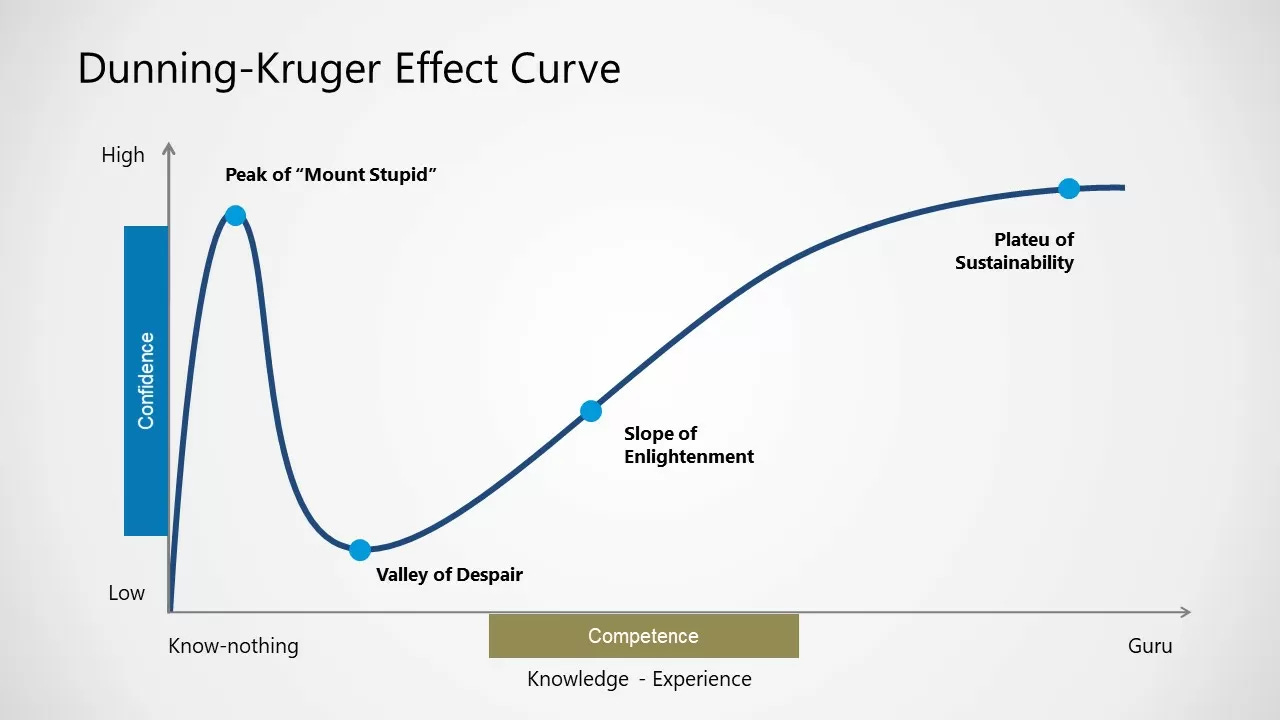
The Dunning - Kruger effect is a cognitive bias of which persons of limited knowledge or skill in a particular expertise tend to overestimate their competence. This is represented on the left hand side of the graph. You can see that as we gain a small amount of knowledge on a subject we often believe that we are becoming adept at it quickly.
Worsening the problem, the material we are consuming is typically beginner material, so we feel like we are comprehending it faster than a typical person would and therefore we must have a “knack” for it.
“Peak of Mt. Stupid” is a bit of a misnomer as we know more than we did a short time ago. Perhaps it should be “Mt. Ignorant” as we have literally no idea the amount that we DON’T know.
Herein is the crux of this bias. Because we don’t know what we don’t know, we are wandering through the dark. Just because we have found an object that we can identify as a chair doesn’t mean we have any idea how big the room, what color the walls are, or even what floor of the building we are on for that matter. All of our confidence is in the idea that we know this is a chair we have found. But we have no idea that the assignment is to describe the entire city block.
This leads us to the Valley of Despair. As we realize that the scope of what needs to be known grows exponentially, we realize that we know almost nothing. It dawn on us that there is a vast forest of subject matter to learn that is much more complex than what we have already learned. On top of all this, there is probably another forest (or forests) beyond this that we can’t even bring into focus.
Fear not. As you can see from the graph, from here both our knowledge and confidence improve. There will be bumps in the road but, for the most part, you control how quickly each rises.
What we control
Wherever you are on the Dunning - Kruger chart when it comes to poker, you must realize that you have the power to get better at this game. Keep reading, keep studying, keep listening, keep playing.
Find a group of likeminded people who want to keep improving with you.
Thank you for railing me! I wouldn’t have had a prayer of going as deep as I did (ICM chop it was, after all) without your perspective and guidance! Now to break my curse of the dinner break bust out…. 🤪