

So I have decided to alternate this series between abstract theory and the applied theory. As an example of abstract theory, last week we talked a bit about what poker is as a game, compared it to some other games, and how luck and skill are combined during play.
Today we will tackle some applied No Limit Holdem (NLH) in game theory.
Preflop
Imagine being invited to navigate the obstacle course of American Ninja Warrior. You are in shape, you have worked out and eaten right for a year. You can be good at all the obstacles they throw at you but if you are horrible at the one at the beginning, you will fail and never even get to show your skills on the rest of the course. The first obstacle is the most important. Period. With that said, lets talk about Preflop.

This is where it all begins literally and figuratively. Every hand you ever play in NLH, you will play preflop. This frequency exceeds that of any other street not exponentially but infinitely. It only makes sense that this is the most important aspect of the hand to get correct.
There are several things you should think about before you act. These include:
Position
Your 2 cards
Stack Sizes
Action before you
Intangibles
Position
Along with your actual cards, position is the most important part of your decision making when the action has folded around to you. It is so important, I decided to list it first because whether you enter the pot or not depends on your cards RELATIVE to your position. You want to have a range of hands that you will open raise (Raise First In - RFI) with preflop from each position.
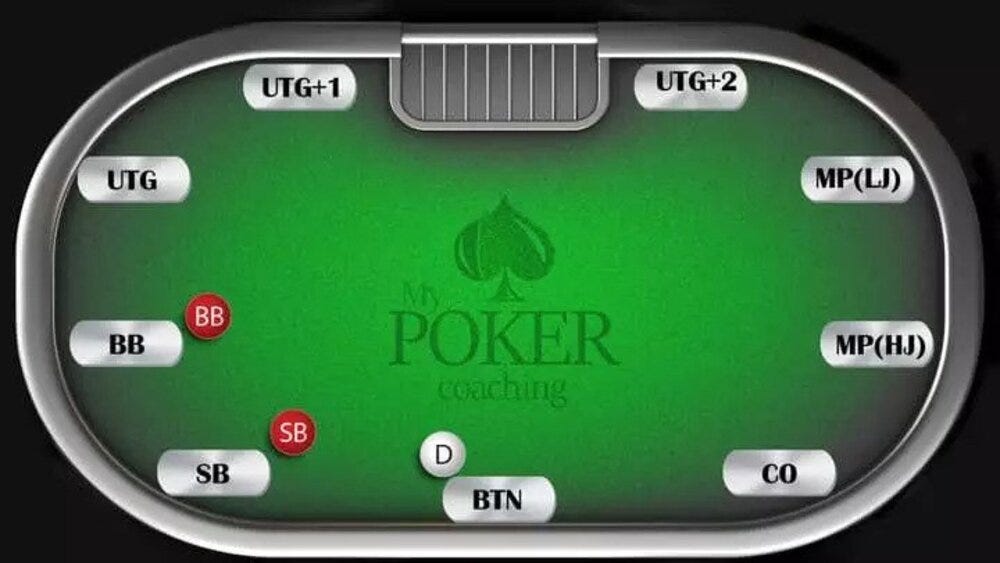
That’s right. Some hands that you will raise with from the best position, you will fold with from other positions. The relative best position is the Button (BTN). From the Button, you will, therefore RFI with more combinations than the other positions. In other words, your Button RFI range will be the widest.


In the above charts which show results at 40 Big Blinds (BBS) deep, the RFI range for UTG (left chart), represents only around 18% of starting hands while the BTN (chart on right) range includes over 50%! If that isn’t eye opening enough, lets look at some of the extreme examples.
Ace 9 offsuit is an open fold from UTG.
6 - 4 suited is an open raise from the BTN.
2 - 2 and 3 - 3 are open folds from UTG.
Every hand with an Ace is a raise from the BTN.
These are the extremes of the spectrum. I am just showing you that you should seriously consider your position when making these decisions. This opening range widens from UTG to the BTN gradually. If you want to see some preflop charts at 100 BBS that you can print out, click Here.
The idea is not to memorize this or the many associated charts but rather to get a feel for what you should be looking for and considering.
Your 2 Cards
This is the obvious consideration when deciding whether to play or not. Rather than rehash some of the things we just spoke of when discussing position, I want to take this opportunity to discuss why the charts only have Raise First In or Fold.
So in NLH, ranges are more easily defined than in some of the other poker variants. On top of this, boards don’t change our holdings as much as in, say, Omaha hi lo. Preflop equities run further away and stay so respective to some games where limping is a preferred strategy. For example, if you have JJ and your opponent is holding something that is behind such as the 98s, the chances of the board changing the outcome is relatively low. When I say relatively, I mean around 20% of the time. I know it feels like that’s a lot sometimes but if you look at an Omaha hi lo game, you will see that one of the best starting hands AhAd2h3d will only have around 65% equity against a random 4 card hand!
It is a commonly accepted heuristic that open raising or folding is the correct way to play NLH preflop.
Another quick point to make is that your open raise sizing should be static among all of your raising range. For example, if you raise to 3x with AA, you should also raise 3x with KJo (King Jack offsuit). If you are consistent with your sizing, you are less likely to be exploited by a player reading your sizing for weakness or strength.
Stack Sizes
You should get in the habit of keeping an eye on your stack size and the size of the stacks of your opponents. Many branches of the NLH game tree are affected by the effective stack size.
Preflop RFI ranges will change based on stack sizes as well. The charts above, for instance, are for 40 BBs deep. If you were to look at the 100 BB chart for UTG, you would see that AJo is a fold but A2s (Ace 2 suited) is a raise. I wont get into why this is the case because, again, this is a beginner course. Just know that stack sizes affect the ranges you should be playing.
By the way, lets say you have 100 BBs and it is folded to you on the BTN. If the Small Blind (SB) and the Big Blind (BB) each have 30 BBs, you are 30 BBs effective. This means that it doesn’t matter that you have all those extra chips. You should play based on the 30 BB RFI chart.
Action Before You
Your preflop decisions should be heavily weighted by the action that has happened before you. Let’s say you have KJo and are in the HiJack (HJ) with 30 BBs. If it were to fold to you, you should open raise to 2.2 BBs. However, if the UTG player raises to 2.2 BBs before you, your KJo now becomes a fold. Remember, the UTG player should have the tightest range. Therefore, the KJo isn’t beating much that UTG player would be entering the pot with. Best case scenario, you are flipping, and worst case you are dominated by a better King (ex. KQ) or a better Jack (ex. AJ).
After spending all that time earlier trying to convince you not to open limp, I will now let you know that it is ok to “limp behind” in certain cases. For instance, a player before you limps in and then it folds to you with pocket 2-2. This is a great time to limp behind hoping to see a flop that will define your hand for the excellent or the horrible. If you graduate to the school of not open limping, you can always relive the good old days when you get to limp behind.
Intangibles
Sometimes, especially in small stakes games, we get to know a player well enough or can catch a tell of sorts that should drastically change our preflop play. Taking a look to our left before acting can be a windfall of information. You will see some players grabbing for chips, others showing disinterest or watching the T.V. Some players will have a grip on their cards ready to throw them in the muck when it is their turn.
Lets run through a few examples and how we can exploit these scenarios:
You are holding the KTo preparing to open raise from early position. After taking a glance, you see a player yet to act sit up in his chair and begin counting out chips. This is a good time to fold your hand. It was a marginal open raise in the first place. Getting called or raised is not what you are looking for in a hand like this. Fold and watch to see if your read is correct. If it is, maybe you will get to see what your not so subtle opponent was holding at showdown.
You are holding the 3-3 from the UTG position and you see the person next to you and the person after holding their cards like they are done with them. (This is called the “Fold Hold”). Your 3 - 3 was supposed to be a fold. However, if you trust your read, this now becomes an open raise. If two opponents are folding, you are essentially getting to play from a better position. This positional change has changed the value of your cards significantly.
You are holding the A-A and prepared to make an open raise from early position. You see multiple players behind you with a very interested look on their faces. One player in late position begins counting her stack. This may be a time to limp. If you trust your read and are right a majority of the time, a play like this can reap huge dividends. If you get a call and a raise behind that, you can reraise and take down a big pot right there. Or, you may be able to get it in with a dominant hand.
These are but a few examples of why it is so important to pay attention while playing.
Books are written about NLH Preflop. There is simply no way I can cover this behemoth of subject matter. If you think I missed something big, please let me know.
Keeping the balance of hitting important concepts and keeping this from becoming a book is what I see as my biggest challenge while writing this beginner course.
As always, please reach out if you have any comments or questions at MikieCulpepper@Gmail.com or leave a comment or like on this post below.
Next topic will be motivation. Your motivation, his motivation, Your perception of his motivation, and his perception of your perception of his motivation.