

Writer’s Note: Besides, perhaps, a small game in which players know and trust each other, a poker dealer is essential. We count on this person to enforce rules, count pots and stacks, read the board and the hands, and, of course, be able to shuffle and deal a fair hand over and over. Even in the example of the small game where the players are friendly and generally trustworthy, a dealer is often preferred out of luxury. The more the player pool looks at the game as recreation, the less that pool wants to deal themselves. Aside from the uncomfortable idea that a player is dealing - and influencing - a hand that he is involved in, it is not particularly relaxing to complete the tasks necessary to deal an honest hand to completion.
Believe it or not, these people do not magically appear before us spreading cards and cheer. It takes coordination, math skills, concentration, discipline, and a LOT of patience. It takes a professional. I sat down with Jeffrey San Gabriel to discuss this and a lot more in the following interview.
Jeffrey is a restart dealer at the WSOP each summer in Las Vegas. A restart dealer is a more experienced - both with tenure and the variety of games in which he is competent - dealer and typically deals, as the name would suggest, the day 2 and day 3 flights. These dealers are expected to be more dependable as the tournament will produce more consequential moments and complicated decisions at this stage. These dealers expect to get pulled as tables break to be sent to another tournament dealing a completely different poker variety. A restart dealer could be dealing a $50K PLO tournament one minute to a $1500 Badugi tournament 15 minutes later. You can learn a lot more on what it takes to be a restart dealer in this entry of Thinking Inside the Box - So you want to be a restart dealer?
I was introduced to Jeffrey through his Substack “Thinking Inside the Box”. I encourage you to read some of his essays especially from this summer. After a bit of communicating online, he reached out to me by showing up before one of my tournaments and introducing himself. We spoke a couple times at this year’s WSOP and I kept thinking about the perspective of the man or woman that is shuffling and pitching these cards. I wanted to know more about the job and now I had a very qualified person to ask. I hope you learn and enjoy half as much as I did putting this together.
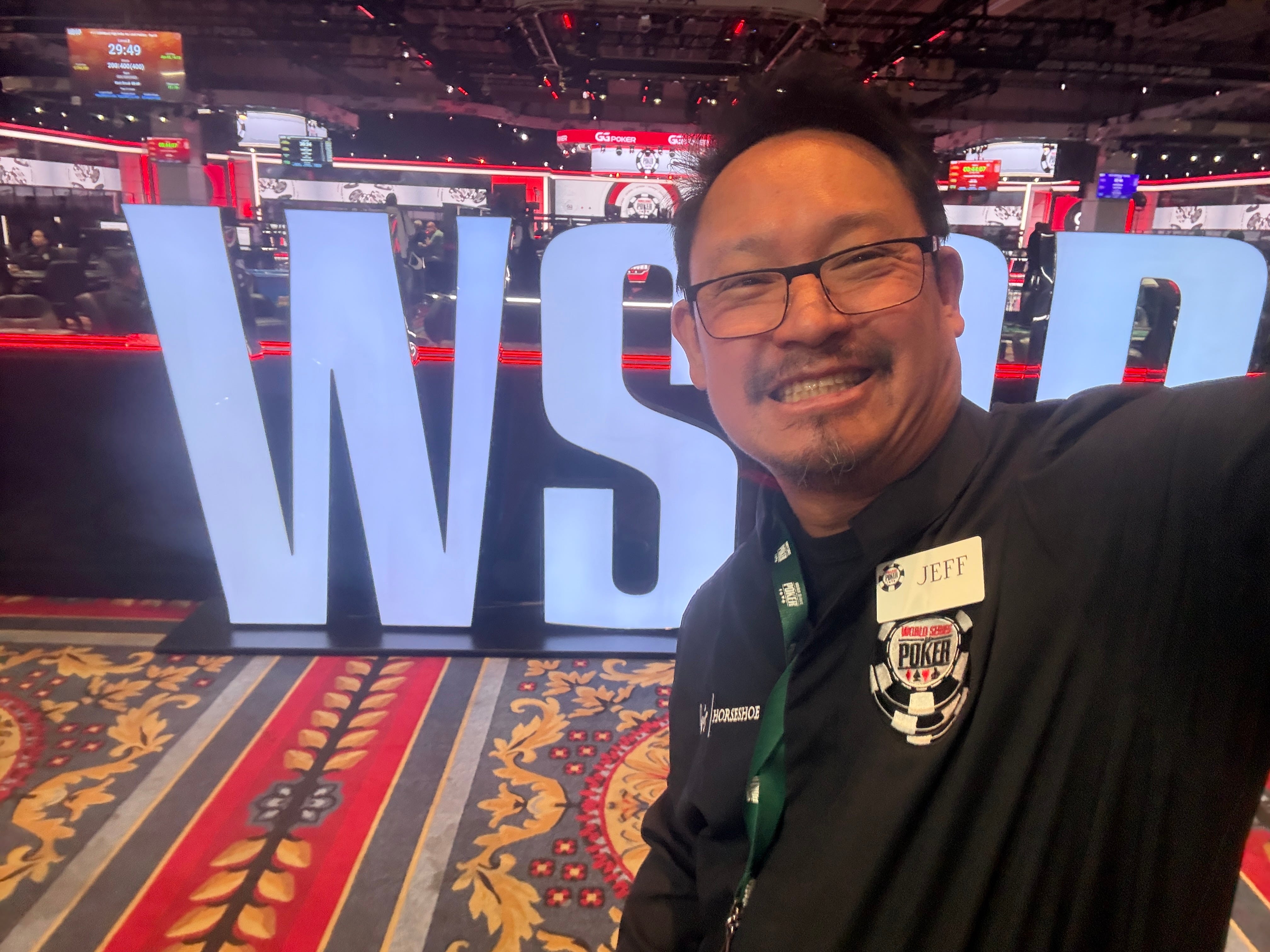
Michael Culpepper (MC): Thank you Jeff for agreeing to take the time for this discussion. Let’s start off with how you started down the path of dealing?
Jeff San Gabriel (JSG): I played a lot of games when I was a kid. Gin, Dominos, Mahjong, Backgammon, and Poker were played at my house from an early age. Stud was most of the poker I was exposed to back then. I learned to deal simply by passing the deck back and forth.
Professionally, I answered a Craigslist ad for a private party game around 2003. This was mostly charity events that didn’t involve money on the table. Then the Moneymaker boom happened and a lot of people wanted to play poker. I was able to improve my dealing and playing skills during this time and meet a lot of people in the poker world. When the WSOP was moving to the Horseshoe / Paris, it was expanding, and needed more dealers. I applied and passed the audition and was hired in late May of 2022.
What I didn’t realize is that I would love dealing as much as I did. When I got back, I applied to jobs in my area (Northern California) and was fortunate to get a job at the Palace Poker Casino which is a short drive from my house.
MC: What drives you to go back to the WSOP each year now that you have a home casino?
JSG: Before I even dealt it, I played the WSOP in 2016 and it was such a great experience that I always - and still do - suggest that everyone go out and play at least once. It is just such a special place in the poker world.
Well as it is special for players, the same is true for dealing the events at the WSOP. The rush of dealing huge events with massive implications…. there is nothing like it. I enjoy the pressure and even the attention that the series brings me. I have other opportunities to deal at other Vegas properties during the summer but I really like the pomp and circumstance around the festival.
MC: What is the most prestigious tournament at the WSOP according to the dealers?
JSG: Just to give you a little background on how the restart team works and I will circle back to answer your question. There were around 2100 dealers hired at the WSOP. Of those about 110 of us are on the restart team. The restart team is responsible for dealing all of the high roller events, all the mixed game tournaments, and the vast majority of Final Tables and live-streamed tables.
We are told what game we will be dealing on the night before as we are relied upon to be flexible to game and start time. There are 2 exceptions - The $250k super high roller and the Pro Players Championship. For these events, there is an interest list of which about 30 of us will be chosen. Of the two, I think the PPC is the more prestigious to deal as it is a 9 game tournament with the best of the best players in the world at many poker variants.
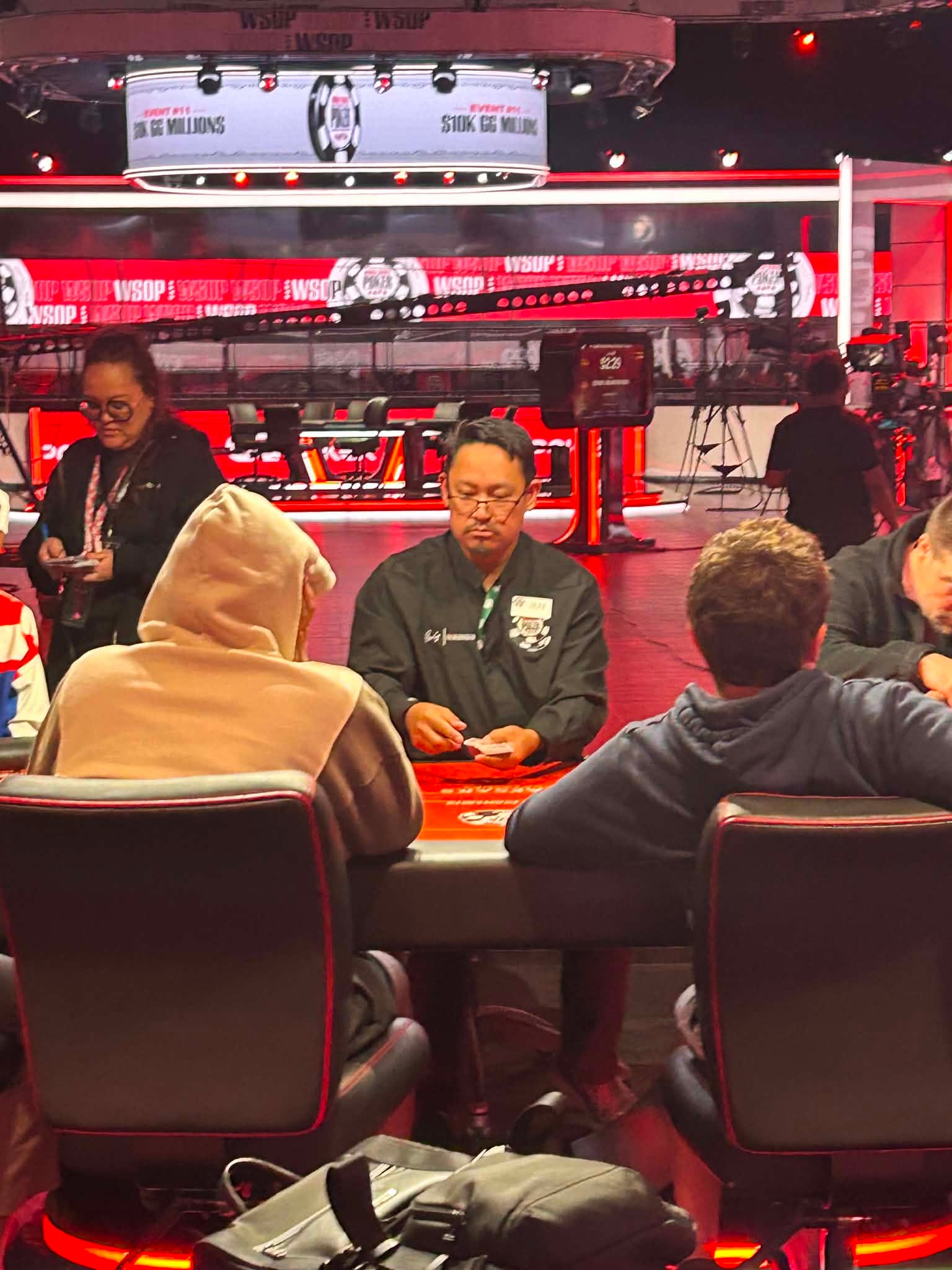
MC: In this banger of an essay, you mentioned the RFID cards that are used on the feature tables - in order for the reader below the table to read the hole cards - as being slightly thicker and awkwardly shaped. Do you have some of these cards with which you can practice?
JSG: [Laughs] - No. We do have a table with cards in the break room for practice and instruction but it is really for beginner dealers to consult with and learn from more experienced staff. The RFID cards are controlled by the production team and not handled until we are almost at the feature table.
These cards are not only different from the typical Copag cards we use, they also seem to vary from year to year. It’s hard to explain the difference but you can feel it if you have dealt as many hands as we have. [pauses] I am a baseball fan and have spoken with pitchers who can handle a ball and tell just by feel that the ball is spongier or that the seams sit higher. There is a tactile familiarity difference only noticed by the very experienced hand when pitching and spreading a flop.
MC: Speaking of pitching cards there is a lot of talk in the industry on switching to a slide deal in lieu of the pitch. It’s already transitioned in parts of Europe and there is talk of Vegas card rooms joining the fray. The push seems to be based on perceived game integrity issues that I would like your take on.
Also, if the switch does happen, do you think it would be an extended learning curve?
JSG: This is coming down from the high rollers primarily. I was always taught to keep my pitch low which I do. This is the first year that I have ever had a player ask me to pitch lower. I of course said “yes sir”, but its obvious that there is major concern about cheating and a general fear of cameras in card protectors and jewelry. There are so many stories out there about private games where players have been cheated and that fuels the paranoia across the board.
I get it. There is a lot of money at stake and these players just want to feel protected by a fair game. Triton has switched and my friend at the Venetian has told me that they have switched.1 So if we need to adapt, we can. - We should.
MC: Speaking of industry pivots and upgrades, the trend of using action clocks (or shot clocks if you fade Matt Savage) got a significant boost in talk this year when they were installed in the Main Event for day 7. Can you let our readers know what is involved when dealing a clock table? What, in your opinion, are some benefits and drawbacks of using a clock? Why aren’t they just used all the time in WSOP tournaments?
JSG: : At the WSOP. iPads are issued by the dealers to monitor the action clock. Pre-flop, players are given 20 seconds to act, then 30 seconds post flop. If a player goes over their time, then they are required to use one of their time banks, which are issued at the beginning of the tournament. Time banks are replenished at specific intervals (usually at the beginning of each day of a multi-day event and often at the beginning of a final table). Time banks are worth an additional 30 seconds. If a player who has not acted and has run out of time banks, they are forced to check (if there is no bet pending) or fold (if they are facing a bet).
Personally, I am in favor of using the action clock for all WSOP tournaments. There are times when I push into a table and the action is slow. After a long day dealing cards, a tanking table can make keeping focused a challenge for an already exhausted dealer.
Unfortunately, having the action clock mandatory at all WSOP events would require a significant amount of training for all 2000+ dealers. Currently, only the Restart Team operates the action clock on a regular basis, as they are required for all the high roller events (buy-ins of $25,000 and higher).
MC: Tell me a bit about the different dealer lanyard colors at the WSOP. What do the colors mean?
JSG: Sure. With about 2000 dealers there just aren’t enough Dealer Coordinators (DCs) so they use the lanyards to identify start times. The color of a dealer’s lanyard simply describes what time he or she started the day.
There were 7 different color lanyards this year and they seemed to have changed all the colors so I cant give you a complete run down or each. However, the idea is as the later shifts come in, the earliest starters are the ones that are relieved of duty first.
The exception is the green lanyard is for the restart team only. The restart team will always be wearing a green lanyard while other dealers change colors daily. This allows DCs to pick us out of a crowd if they need a dealer in a mix game if they are short dealers. Sometimes I have the option of going to the new game and sometimes I don’t.
MC: Speaking of experience in dealing, I’m interested in how you handle a mistake. I will give you two examples.
The first is a small mistake happened in the Stud-8 event I played where after dealing third street, the dealer started his motion to put out a flop. The entire table went “Woah!”, he was able to recreate the stub and we moved on unscathed except, perhaps, a very small amount of embarrassment on the part of the dealer.
The second - pardon the pun - was more colossal as the final hand of the Colossus was misdealt heads up and had an impact on the outcome of the tournament.2
How does a dealer handle mistakes and keep them from leading to more mistakes?
JSG: I think - thankfully - players know that mistakes happen
So I usually classify mistakes a lower case “m” and upper case “M”. You don’t want to commit either but the lesser is a lot easier to get over.
There isn’t a Stud dealer that hasn’t attempted to deliver a flop. It’s just going to happen sometimes due to muscle memory. It’s a lower case “m” mistake as you suggested. We try to just laugh it off and move on.
As far as a snowball effect, its a good idea to not make things worse. When I first started at the WSOP, I made a key mistake. I had dealt a premature turn card and I was able to stop, get off auto pilot and recreate it without making things worse. I tried to be very conscious of my next physical action while trying to repair a mistake.
My advice to new dealers of a stream or final table will be to go SLOW. Think of each action before making it. Even if you believe you are going slow, go a little bit slower. The players are taking their time in this big moment and the dealer should as well. In tournament dealing, accuracy should be the emphasis.
As for the Colossus hand, we don’t deal heads up very much. I know the dealer and he felt terrible. We never want our work to dictate the outcome of a tournament. But I also must say that this shouldn’t be all on the dealer.3 There were two players there as well that presumably know the rules and could have caught the error as well.
With all that said, it is hard to not dwell on these things after the fact. You have to somehow separate the learning from a mistake from the beating yourself up. It does get marginally easier with time and experience but part of that is probably because [you] tend to make less mistakes with the experience.
MC: This year at the Series, a rating system was added. When this system was introduced, there was a bit of backlash and debate over how it could be used or abused. How do you think the dealer rating system went in year one?
JSG: The WSOP uses the dealer rating system as a reward program for the bracelet events. They took $100,000 out of their own pockets and gave out these bonuses. $1000 in rewards were given out for each bracelet event. $500, $300, and $200 were given to the 1st, 2nd, and 3rd best rated dealers in each event respectively.
Many of us were skeptical of the rating system when it was first announced. We were concerned that players would give us low ratings after dealing bad beats (which happens more often than you’d think). But for the most part, that didn’t happen. At the end of the summer, I received a 2nd place award, which I was very pleased with. There are a lot of very good dealers on my team, so getting acknowledged was gratifying.
There was a lot of opinions thrown out by players before the series but I didn’t hear much feedback afterwards. I wonder what they thought of the rating system.
MC: I can give you the player perspective I have heard most in the aftermath of the summer as I share the sentiment. I thought that a comment section below the rating would have been really helpful. If a dealer did everything right except he was pitching extremely slow or he was too chatty, players would like to note the reason they gave 4 stars instead of 5. We felt like it could potentially provide direct feedback on a spot she could work on.
MC: How is the Dealer of the Year voted on? Is this a sought after accolade?
JSG: The floor supervisors, tournament directors, and DCs nominate and vote for the Dealer of the Year at the end of the Series. It is very sought after. If you win DOY you are automatically at the Main Event final table.
It is an honor we all strive for. The restart team takes a lot of pride in our work. We are recognized as being excellent in our craft and profession. We are also very competitive and that helps us push ourselves to be our best. To be acknowledged as THE best in this group is the highest honor in our profession.
MC: There are a couple players getting a lot of attention from poker media for the unusual way they behave at the table. One player in particular is almost constantly using speach play with his opponents but also, seemingly, working the dealer verbally in a quizical or confrontational manner.
How do you handle this situation internally?
JSG: Players are always looking for an advantage. The excessive talking does seem to push the edge of what is reasonable at times. I have been around a lot of those players and I am able to keep pretty calm when the players are talking to me. I feel like I have an advantage in that I may handle this better than most dealers. I am able to stay more relaxed and address them back. Most dealers will try to stay quiet and that can lead to discomfort sometimes.
I don’t want to say it isn’t weird, because it is, but I am lucky that it doesn’t bother me.
MC: What do players do that makes your job a lot harder and what can players do to make the game run smoother?
JSG: When players bet and fold “short”. This is to say, they bet and put their chips barely out in front of them and make no effort to slide the chips further to help me gather them.
Constantly having to reach for one player’s chips gets old. The same with folded cards. Help me out a little bit.
When there is at least one player at the table that helps me out and knows whats going on and what is happening next, it is very welcomed. From pushing the aforementioned players chips or cards forward to making change without asking and making the small blind or ante correct.
MC: Thank you very much for your time. I appreciate you visiting with me this summer and I am excited to share your perspective with our readership.
JSG: You’re welcome. It was a pleasure.
If you enjoyed this interview, please consider liking it or perhaps subscribing.
Also, make sure you check out Jeff’s substack.
I have read that SouthPoint has also switched its room to slide dealing.
In heads up play, the Button is the SB and the other player is the BB. In this setup, the BB should get the first card dealt as the Button should always get the last.
On the first hand of heads up play, the dealer of the Colossus mistakenly dealt the Button first. Therefore each player had the hand which his opponent was entitled. This proved to be the last hand of the event as the shorter stacked player got his 88 all in vs AK. The AK won on a flush. Had the cards been properly pitched and the all in had occurred, stacks would have been close to even after the hand.
I completely agree with Jeff here. We - as players - need to be paying attention and speaking up when we see something we aren’t sure about.